
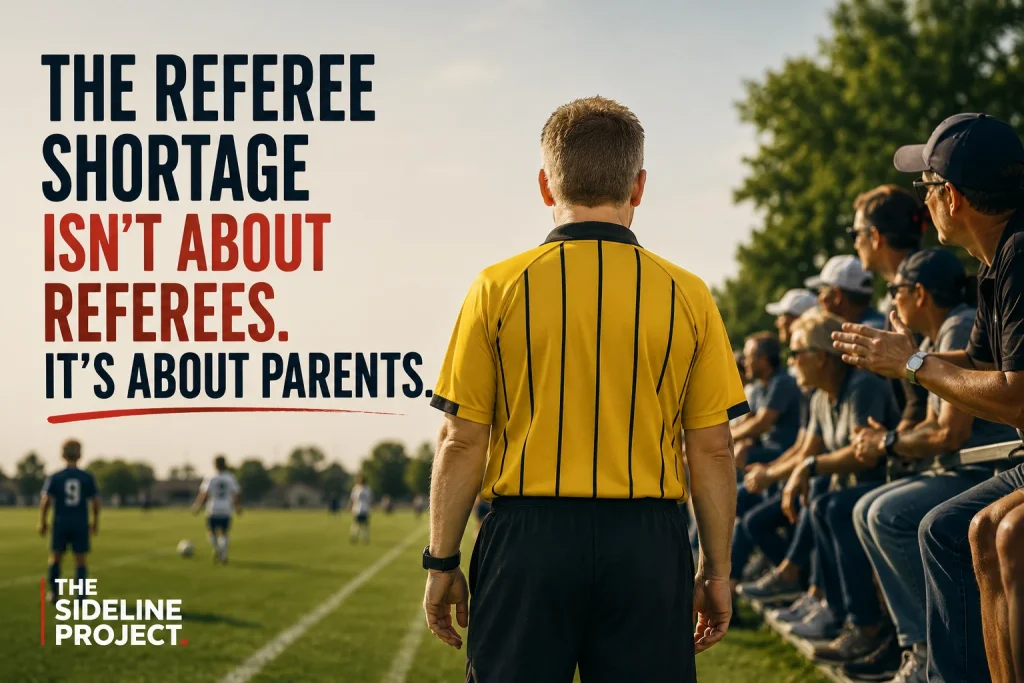
Last weekend, my son's soccer game almost didn't happen. The refs didn't show up. State Cup in Indianapolis had pulled every available official out of the area, and both teams stood there on the sideline wondering if they'd made a long drive for nothing.
So I offered to ref. A couple of parents grabbed the flags. And we played.
It was one of the best youth soccer games I've ever watched. Parents were laughing. Joking around with me on the touchline. Cheering their kids without the usual edge. Nobody barked at a call. Nobody questioned an offside. In the last ten minutes, when the competitive urgency usually peaks and the sideline commentary gets ugly, people were relaxed and happy. It was, genuinely, just soccer.
I've been in this exact situation about ten times over the past few years. Refs don't show, I step in, same thing happens every time. The atmosphere is totally unlike a normal game. And I think I know exactly why.
Before I agreed to ref, that game wasn't happening. Those parents had driven however far, packed the kids in the car, gotten there early, and were staring at the possibility of turning around and going home. Their kid wasn't going to play. Then I said yes, and they could. And the moment that happened, something clicked. They remembered what they were actually there for. They wanted their kid on that field, having fun, getting better, competing. Once they had that, they protected it. Nobody was going to risk the game by making the volunteer ref's afternoon miserable.
That's the deep insight parents get when the game almost doesn't take place. And it shouldn't require a crisis to get there.
The Referee Shortage in America
The referee shortage in American youth soccer has gotten bad enough that leagues across the country are routinely canceling games and scrambling to fill spots with whoever will say yes.
Only about 20% of referees are still officiating by their third year.
One in five. Let that sink for a moment.
The other four quit, and they quit for pretty predictable reasons: the pay is lousy ($25 to $50 per match is the typical range, which doesn't cover much once you factor in the emotional wear) and the sideline behavior is brutal. Teenage referees, which is most of them at the youth level, are getting screamed at by grown adults who apparently forgot that they're watching 12-year-olds play soccer on a Saturday morning.
I've seen parents scream at referees young enough to be their own kids. I've seen coaches lose it over a U10 offside call. The referee shortage is affecting youth soccer leagues across the country.
I've seen parents from opposing teams get into actual physical confrontations. Not arguments. Fights. Over youth recreational soccer. Many parents don’t realize how serious the referee shortage has become.
I've watched a 16-year-old ref try to maintain composure while two 40-year-old men berated him from opposite sidelines, and I've thought: how long before he decides this isn't worth it?
The answer, statistically, is not long.
The math here isn't complicated. When refs quit faster than new ones get certified, there are fewer refs. When there are fewer refs, games get canceled. When games get canceled, your kid doesn't play. The chain from "dad screaming at a teenager about a foul call" to "sorry, we couldn't find officials for Saturday's game" is short and direct. You just don't see it because there's usually a ref standing there absorbing it before it gets to that point.
On the day there isn't, you see it clearly.
Parents Can Channel Their Behavior Differently
Here's what I keep thinking about from that game. At no point did those parents stop caring about their kids playing well. They still cheered hard plays. They still called out encouragement. The competitive interest didn't disappear. But they channeled it differently because the context was different. They understood, in a concrete and personal way, that the game existed because someone agreed to officiate it. And so they treated that person accordingly.
That's all refs are asking for. You don't have to applaud every call. You don't have to agree with every decision. But the ref standing in the middle of that field is the reason the game is happening at all. Without a licensed official, most leagues can't run a match. Without matches, there's no season. The whole structure depends on people being willing to show up and do a difficult, underpaid job while you watch from the touchline.
When you scream at them, some of them decide they'd rather do something else on weekends. You probably can't blame them.
A few things worth understanding about refs, especially youth refs. They're not professionals. The teenager running your U12 game on Sunday morning certified recently, probably took a one-weekend course, and is still learning. They will get things wrong. That's not a malfunction, it's a normal part of how anyone learns a skill.
The 14-year-old who blew a foul call in the 30th minute isn't the enemy. And treating them like the enemy doesn't produce better officiating. It produces a teenager who decides refereeing isn't worth $35 and never comes back.
The refs who do stay, the ones who make it past year three, tend to be the ones who learned to develop thick skin because the culture demanded it. That's not a system you should feel proud of. A lot of good officials leave before they develop that resilience, and the ones who stay do so in spite of the environment rather than because of it.
There are programs trying to fix this. Some states have worked on raising match fees. Several leagues have formal sideline conduct policies with real consequences, yellow cards for coaches and parents, ejections, forfeited games. Those help at the margins. But the math on $50-per-match pay is hard to overcome if the emotional cost keeps climbing.
The most effective thing you can do is also the simplest. Treat the ref like the game depends on them.
Because it does.
Don't wait for a no-show Saturday to figure that out.
When your kid's next game kicks off and the ref makes a call you hate, ask yourself: is this worth it?
Not worth it to me, since I'm not the one running up and down the field trying to manage 22 players while 50 parents watch. Worth it to them. Is yelling about this call worth making this person feel like their Saturday morning was a waste of time? Is it worth nudging them toward quitting?
Because that's the actual trade-off. It's not your frustration versus nothing. It's your frustration versus whether a ref shows up to your kid's game in two weeks. The referee shortage is now impacting leagues, coaches, players, and families nationwide. You can learn more about youth soccer referees here.
The parents at that low-ref-count game last weekend had an unusually clear view of that trade-off. They got lucky, in a way. Most parents don't see the connection until the games start getting canceled, and by then it's too late to thank the refs they drove off.
Don't wait for the shortage to reach your doorstep. Show up already knowing what the ref is worth.

Matt! What brilliant recognition. Thank you for communicating and highlighting the power in this.
We have a 10 year old granddaughter playing a rec league as she still decides on soccer, and the spectators already know there is some probability of a Dad being recruited to ref.
As we approached a game just a few weeks ago, she yelled out to her 12 year old brother that he may need to ref, as none of the Dads appeared to be available. He knows the game, but spends his time with baseball and basketball. BUT, their 9 year old sister is a Junior Academy standout, highly intelligent, and an old soul. She jumped at the chance! (I have already been in her ear about what a great job being a ref CAN be, and how it can inform her own play.)
I gave them a few quick tips for their two-man system, and off they went.
Then she turned back and asked “Do we inspect their cleats, and everything?”
I said, “Do it all! You are the ref, and you know the game as well as anyone here.”
It was a similar enchanting sight, with parents and players respecting two kids willing, in fact excited, to help the game happen.
Thanks again for highlighting an alternate perspective that is so powerful!
Love that Tim!
I didn’t mention it in the article but one of the best moments of the game was when a player scored and one of the ARs was his older brother (like 2 years older so close enough in age) and he was called offsides.
It was close… close enough that I looked straight to him and let him make the call. I didn’t know at the time they were brothers so I wondered why the younger brother ran over to him and gave him crap. But I could tell something was up because everyone was laughing. The players were hounding him, but in a playful way.
All in all, such a different experience. And one that SHOULD be the norm.